




Digital PR
Digital PR vs traditional PR vs link building: which one does your brand actually need?
What traditional PR, digital PR and link building each deliver, where each one stops working, and why most brands are being sold the wrong one.
 Johnny GreaneyHead of PRPublished · Updated · 6 min read
Traditional PR, digital PR and link building do different jobs and get judged in different ways, and much of what gets sold as link building is something Google is actively working to cancel out. Pick the wrong one and you can spend a year’s budget on links that count for nothing.
Which one do you actually need? Start with what each of them does.
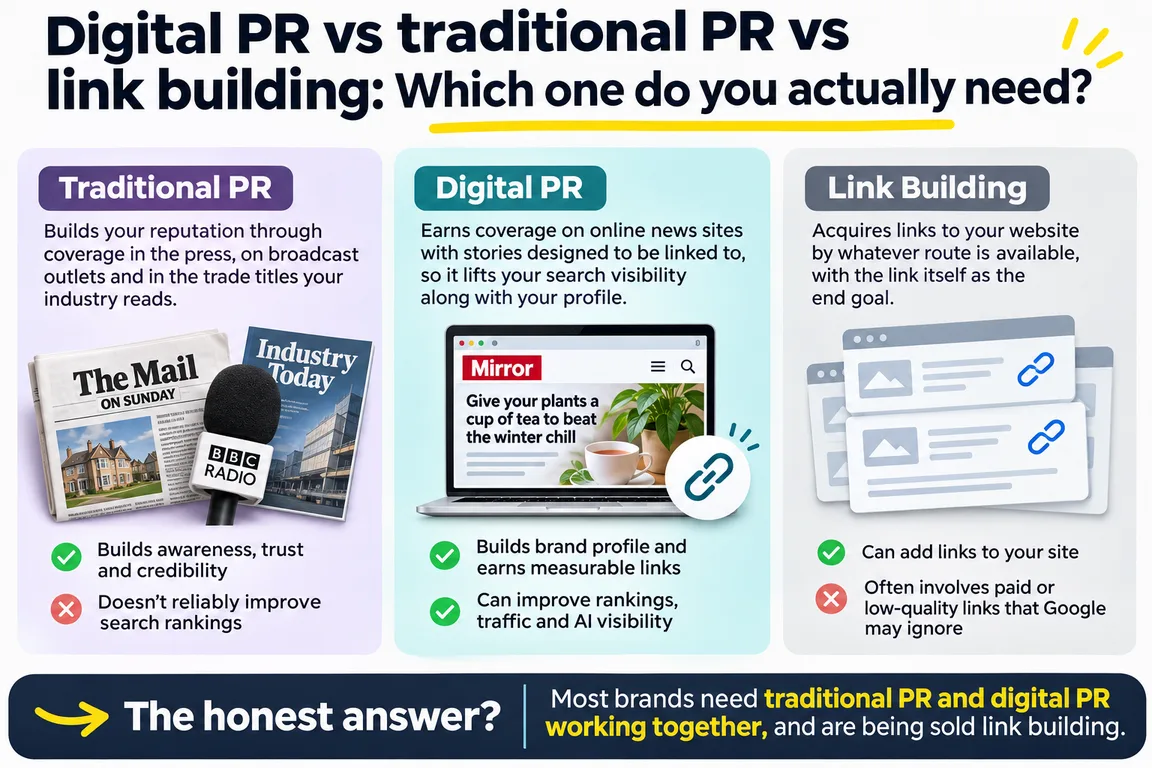
Traditional PR builds your reputation through coverage in the press, on broadcast outlets and in the trade titles your industry reads.
Digital PR earns coverage on online news sites with stories designed to be linked to, so it lifts your search visibility along with your profile.
Link building acquires links to your website by whatever route is available, with the link itself as the end goal.
So the honest answer to the question is that most brands need the first two, working together, and are being sold the third.
We’ve had plenty of clients over the 13 years marco/richards has been in business who arrive wanting just one. When we started out it was mainly traditional PR, later they were digging digital more.
We explain why both approaches need to be in operation and we go from there - very often with spectacular results.
| Approach | Main benefit | Best for |
|---|---|---|
| Traditional PR | Reputation and credibility | Awareness, trust, crisis management |
| Digital PR | Online coverage and earned links | Search authority, visibility and reputation |
| Link building | Acquiring backlinks | SEO, provided links are earned legitimately |
- Approach
- Traditional PR
- Main benefit
- Reputation and credibility
- Best for
- Awareness, trust, crisis management
- Approach
- Digital PR
- Main benefit
- Online coverage and earned links
- Best for
- Search authority, visibility and reputation
- Approach
- Link building
- Main benefit
- Acquiring backlinks
- Best for
- SEO, provided links are earned legitimately
What traditional PR does… and what it doesn’t
Traditional PR is how a brand becomes known and trusted by the people who matter to it.
That means a founder interviewed on regional radio, a spokesperson quoted in a national newspaper, or a considered piece in the trade magazine that every KOL in the sector reads.
It’s also the discipline you lean on when things go wrong, because a relationship with a journalist built over years is worth more in a crisis than any amount of content.
What it does not do, at least not reliably, is move your search rankings. A broadcast interview carries no link. Print coverage carries no link. Plenty of trade titles won’t link out at all.
Traditional PR was never designed to be measured in clicks and judging it by them misses the point.
Just last month we landed a fantastic piece of coverage in the Mail on Sunday for our property client We Buy Any Home. Big readership, bang-on the demographic. Lovely stuff.
What digital PR does
Digital PR takes the same instincts - what the story is and who would want to run it - and applies them to online news.
The raw material is usually data campaigns, expert comment on a moving news agenda, or a reactive quote delivered while a story is still live. The output is coverage on news sites that link back to the client’s website.
That makes it measurable in a way traditional PR is not. You can count the coverage, count the links, then watch what happens to rankings and organic traffic.
Our work with Prestige Flowers shows what that looks like sustained over time: 2,456 pieces of coverage and 1,600 backlinks across 32 months. That averages out at 50 earned links a month, every month, for nearly three years. Not one was paid for - each exists because a journalist decided the story was worth running.
One story in particular captured the imagination of online news and feature editors. It turns out plants, like every English person, like nothing more than a lovely cup of tea to beat the winter chill. Chin chin.
What link building does and why Google can tell the difference
Link building, in its narrow sense, means getting links by any means: directory listings, guest posts, link swaps and, very often, payment. Some of it is harmless housekeeping. Much of what is sold under the name is not.
Google’s position is not ambiguous. Its spam policies define link spam as creating links to or from a site mainly to manipulate search rankings, and the first example given is buying or selling links for ranking purposes, including paying for posts that contain links or trading goods or services for them.
Paid links are not banned outright. Google accepts that they are a normal part of advertising and sponsorship, provided they are labelled with a no-follow or sponsored attribute, and Google generally won’t count a link labelled that way towards rankings.
Enforcement is increasingly automated. Google says its SpamBrain system can detect both the sites buying links and the sites that exist to sell them, and its stated aim is to neutralise unnatural links.
In practice, that means the most common outcome of buying links is not a dramatic penalty. You pay and the links usually count for nothing.
A link from a news site is a different thing entirely. A journalist put it there because your data or your expert made their story better, and that independent editorial judgment is exactly what Google is trying to measure.
Google’s John Mueller has said publicly that good digital PR is at least as important as technical SEO, and that it’s a shame it gets lumped in with spammy link building.
I spent more than two decades as a journalist on local and national titles, and the only way I was giving links was if the copy was well written and worth reading. (AI-slop pushers: Take note!).
Which one do you need?
If you’re launching, start with traditional PR for awareness and credibility, and run digital PR alongside it so the brand name people hear about is one they can find when they search.
If you are rebuilding trust, this is traditional PR territory. It calls for careful media relations, a credible spokesperson and patience, and no volume of links will fix a reputation problem.
If you are losing search visibility, look to digital PR. If competitors are outranking you and your content is sound, the gap is usually authority, and authority comes from links earned on sites already trusted by Google.
If you want to appear in AI answers, you need both. AI assistants lean heavily on third-party sources: Muck Rack’s latest analysis found that earned and third-party sources account for roughly 84% of AI citations, with journalism making up 27%.
Coverage is the input, whether it carries a link or not. And the shortcut is closing here too, with Google’s spam policies now extending to attempts to manipulate generative AI responses in Search.
Your questions answered
Does digital PR improve rankings?
Yes, when it earns relevant links from authoritative sites and the pages they point to deserve to rank. Links are one ranking factor among many, so digital PR works best on a site that is technically sound and has content worth finding.
How many links does a digital PR campaign earn?
It varies enormously. A single campaign might land a handful of links or several dozen, depending on the story and the news agenda that week.
Our Prestige Flowers campaign averaged 50 a month over 32 months, which was all down to the marco/richards team’s sharp eye for an appealing news angle and a client keen to engage and sign off on the quotes quickly.
Is digital PR just SEO?
No. It serves SEO but the craft is journalism: finding a story, standing it up and getting it to the right person at the right moment. At marco/richards we only employ former journalists.
The brand awareness and credibility that come with the coverage would be worth having even if search engines didn’t exist.
Can digital PR help with AI search?
The evidence so far says yes. AI tools draw overwhelmingly on earned and third-party sources over brands’ own websites, so being quoted and named in credible coverage is the most direct route into their answers.
How long before digital PR affects traffic?
Coverage and links can land within days. Ranking and traffic changes take longer, typically three to six months of consistent activity, because Google needs time to find the links and reassess your site.
Not sure which one you need?
Tell us what you’re trying to fix and we’ll give you a straight answer on whether it’s a job for traditional PR, digital PR or both. Have a look at what we do, or book a free hour with the team.